After a herniated disc you can usually train again once you are pain-free at rest, have no remaining neurological deficits, and tolerate an hour of brisk walking without your symptoms increasing. With conservative treatment that point is often reached after four to eight weeks; after surgery, structured exercise typically starts four to six weeks post-op. The timing follows these criteria, not the date of your diagnosis. For a full return to your own sport, plan for three to six months.
Roland S. came to me with two herniated discs and a sentence I have heard many times in twenty years: sport was off the table now. He was 47, had played tennis for years and trained three times a week. After the MRI report he had done almost nothing for eight months, afraid of breaking something.
The pain had not improved in that time. That is the part that surprises most people. He had done everything he was told. It was just that "rest" had never been a plan. It was the absence of one.
We started from zero, with walking and three exercises. After roughly six months he was training as before, tennis included. Not because of a miracle, but because someone finally managed the load instead of avoiding it.

What the scan tells you and what it does not
An MRI shows structure. It does not show how much load you can handle, how strong your muscles are, or how much pain you are in. That sounds like a technicality. It is the single most important point in the question of returning to sport.
A systematic review by Brinjikji and colleagues analysed imaging from more than 3,000 people without back pain. Disc bulges were found in 30 percent of pain-free 20-year-olds and in 84 percent of 80-year-olds. Disc protrusions, meaning actual herniations in the broader sense, appeared in 29 percent of 20-year-olds. These people had no symptoms. They did not know about their findings (Brinjikji et al., AJNR 2015).
That does not make your scan irrelevant. It means the scan alone does not decide anything about your sport. What matters is the combination of imaging, symptoms and function. When a picture and your body disagree, the body is usually closer to the truth.
There is something else that rarely gets mentioned: herniated discs frequently resolve on their own. A review by Chiu and colleagues assessed 31 studies. Nine of them were suitable for calculating regression rates, which came to 96 percent for sequestrations, 70 percent for extrusions and 41 percent for protrusions. The findings that sound most dramatic in the report are the ones that disappear most reliably (Chiu et al., Clin Rehabil 2015).

Four criteria instead of a calendar date
"Six weeks off" is a convenient answer. It simply does not account for whether you are actually ready after six weeks. Two people with the same scan can be in completely different places six weeks later, depending on training history, job, sleep and stress load.
In practice I use four criteria. All of them have to be met before structured training starts.
Sitting, lying and standing are pain-free or close to it. As long as rest hurts, the irritation is still too acute for additional load.
No numbness that is spreading, no loss of strength in leg or foot. Neurological signs belong in a medical assessment, not in a training plan.
One hour of brisk walking in one go, without symptoms rising during it or the following day. That is the entry ticket for everything else.
What counts is not how training feels, but how you feel 24 hours later. If the morning is worse, the dose was too high.
The fourth criterion changes the most in practice. Disc tissue responds with a delay. Anyone who only listens to how a session feels while it happens will underestimate the load, reliably. The next morning is the more honest measuring instrument.
The pain rule I work with
"Only up to the pain threshold" is useless as an instruction, because everyone draws that line differently. So my clients get a number. Pain is rated on a scale from 0 to 10, and three conditions have to hold:
- During the exercise, pain stays at 3 out of 10 or below
- After the session it drops back to baseline within 60 minutes
- The next morning you are no worse than the day before
If all three hold, the dose was right, even if it felt uncomfortable. If one is broken, you step back one level, not all the way to zero. The principle comes from tendon rehabilitation and has worked just as well for back problems in my experience. It takes the fear out of movement without playing the problem down.
One detail that often gets missed: pain radiating into the leg weighs more than pain in the back itself. If symptoms move from the leg towards the back during a set, that is a good sign. If they travel from the back further down the leg, you stop.
The signs that mean you do not train
There are situations where every training question becomes secondary. With these signs you seek medical assessment immediately:
- Numbness in the saddle area: inner thighs, perineum or buttocks
- Problems with urination or bowel movements, especially losing the sense of needing to go
- Weakness that is increasing, such as a foot catching when you walk
- Severe pain combined with fever, unexplained weight loss, or following a fall
The first two can point to cauda equina syndrome. That is an emergency, treated within hours rather than days. Such cases are rare, but they are the reason no article and no coach replaces a medical examination.
Returning in four stages
Once the criteria are met, the build-up follows. I work in four stages, and each has a target that must be met before the next one starts. The timeframes are experience, not rules.
Stage 1: walking becomes training
Walking is the load discs tolerate best and need most. Discs have no blood supply of their own; they are nourished through pressure changes. For them, movement is metabolism.
A study by Belavý and colleagues found higher water and proteoglycan content in the discs of regular runners compared with inactive people. What stood out was the load associated with it: accelerations around 2 m/s, meaning brisk walking to slow jogging (Belavý et al., Sci Rep 2017). One caveat: this was a cross-sectional study. It shows an association, not proof that running builds disc tissue.
In practice: walk daily, starting at 10 to 15 minutes, adding roughly five minutes every two to three days. The target is one hour at a brisk pace, in one go.

Stage 2: core before weight
Before load comes back, the spine needs musculature that keeps it quiet under that load. That is exactly what the McGill Big 3 train: curl-up, side plank and bird dog. They place very little demand on the disc and teach stabilisation in a neutral spine position.
Two to three sessions a week, short holds of eight to ten seconds, several repetitions instead. Not to failure. The goal is control, not burn.
Stage 3: strength with a controlled spine
From here resistance comes in, starting with exercises where the back stays neutral and the legs do the work. Leg press through a limited range, seated rows, hip thrusts, later deadlifts with dumbbells from an elevated position.
The most common mistake here is not too much weight, but too many changes at once. Change one variable per week: either more weight, or more repetitions, or a new exercise. Never two together. How to progress load sensibly is covered in more depth in the guide to strength training after 40.
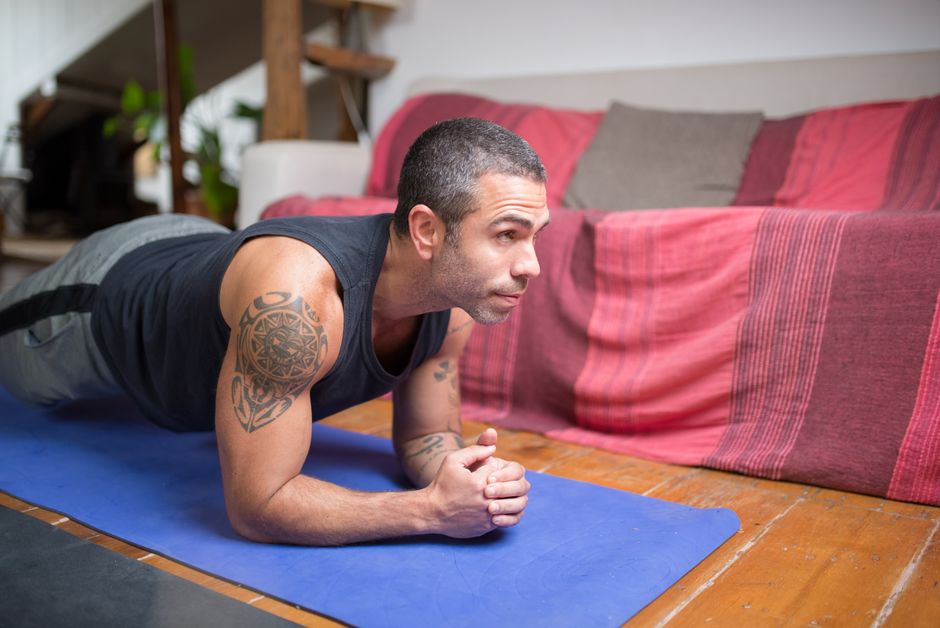
Stage 4: back into your sport
Only when stage 3 has been stable for several weeks does the actual sport return, and it returns in parts. Tennis starts with baseline strokes and no serve. Running starts with walking and inserted minutes of jogging. Football starts without contact.
For most clients this stage takes two to three months. Skip it, and you frequently end up back at stage 1.
Which sport comes back when
Blanket lists of forbidden sports help very little, because they ignore dose. Tennis is not dangerous; a three-hour match after eight months off is. Still, there is a sensible order in which I bring sports back.
Early on, usually from week two to four: walking, cycling on flat ground in an upright position, swimming on your back or front crawl. Breaststroke with the head held up loads the lumbar spine more and comes later.
Middle phase, usually from week six to twelve: machine-based strength training, cross-trainer, Nordic walking, easy running on soft ground, yoga without deep forward folds into a rounded back.
Later phase, usually from month three to six: tennis, golf, football, mountain biking, martial arts, heavy free-weight training. These are the sports with fast rotation, impact or high axial load.
If your job involves a lot of sitting, what happens between sessions often matters more than the sessions themselves. What actually helps during an office day is covered in the article on back pain at the desk.
When the herniation sits in your neck
Almost everything written about sport after a herniated disc refers to the lumbar spine, where most herniations occur. Some sit in the cervical spine, and different rules apply there.
The basic logic stays the same: no neurological deficits, no pain at rest, gradual build-up. What differs is which loads cause problems early. With a cervical herniation it is downward pressure and overhead work, plus holding the head in one position for long periods.
In practice that means overhead pressing, pull-ups, upright rows and any hard impact to the head come back late. Cycling in a low road-bike position loads the cervical spine more than most people expect, because the head is held against gravity for a long time. A higher handlebar, or a switch to a gravel bike, often solves it.
What works well early: walking, leg training with a neutral head position, rowing with an upright torso, and isometric neck work against light resistance from your own hand. If you spend the day at a screen, check the setup as well. The neck will not recover in one training session from eight hours of holding a forward position.
Surgery or not: what actually changes
Many people assume surgery speeds up the return to sport. The data do not support that.
A meta-analysis by Sedrak and colleagues examined elite athletes with symptomatic lumbar disc herniation: 799 treated surgically, 308 conservatively. Return to play was achieved by 83.0 percent of the surgical group and 81.5 percent of the non-operative group. The difference was not statistically significant. Mean time to return was 5.2 months after surgery and 4.1 months without (Sedrak et al., Sports Health 2021). The authors note the limitations themselves: mostly observational studies, with considerable heterogeneity between them. As evidence that surgery shortens the road, the data do not hold up.
If you have had surgery, what changes is the starting point, not the logic. A Cochrane review by Oosterhuis and colleagues covering 22 studies with 2,503 participants found that exercise programmes starting four to six weeks after surgery reduce pain and disability faster than no treatment. More intensive programmes performed slightly better than cautious ones. In none of the trials did the reoperation rate increase (Oosterhuis et al., Cochrane 2014). The authors rate the quality of evidence as low to very low, which has to be said alongside it.
The practical message holds regardless: fear of loading after surgery is less well supported by the data than the loading itself.
Three mistakes that delay the return
The first is rest as a permanent state. "Take it easy" is a comfortable piece of advice, and it is the one training plan people follow without fail. Beyond an acute phase of a few days it costs muscle, capacity and confidence. Roland S. had eight months of it behind him when we started.
The second is jumping straight back to the old numbers. Someone who lifted 100 kilos before the herniation does not start at 80. They start at a weight that feels almost embarrassing, and add to it weekly. Ego is the most expensive training partner there is.
The third is ignoring the rest of the system. Poor sleep and sustained stress worsen both pain processing and tissue recovery. Someone sleeping six hours and working fifty does not have a purely training-related problem. Those connections are exactly what we work through in the Blueprint Session: load, recovery and daily life as one system rather than separate building sites.
Which leaves the question Roland S. asked at the start: will it be like before? In his case yes, after around six months. For others, not entirely. What can be changed in almost every case is the direction. And that starts not with a week in the calendar, but with the first walk.
How long do you have to avoid sport after a herniated disc?
There is no fixed number. The acute phase with real rest usually lasts a few days to two weeks. After that the build-up starts with walking and light stabilisation work. Structured training begins once you are pain-free at rest, have no neurological deficits, and tolerate an hour of brisk walking without symptoms increasing. For most people that point falls between week four and week eight.
Can I do strength training with a herniated disc?
Yes, once the acute phase is over and there are no neurological signs. Strength training is one of the most effective measures against recurring back problems. What matters is selection and dosage: first core stabilisation in a neutral spine position, then guided exercises through a controlled range, and free weights last. Loaded flexion, meaning bending the lumbar spine under weight, comes at the very end or not at all.
Is running allowed after a herniated disc?
Usually yes, but not as the first load. Running typically returns from week six to twelve, once an hour of brisk walking is comfortable and core strength has been built. Start by alternating walking with one to two minutes of jogging on soft ground. There is little against running itself: studies of regular runners show better disc properties than in inactive people.
Which sports should I avoid after a herniated disc?
Permanently, usually none. In the first three to six months it makes sense to postpone sports with fast rotation and impact: tennis, golf, squash, football, martial arts, mountain biking on rough terrain, and heavy free-weight training overhead or in flexion. The dose and the timing matter more than the sport itself.
When can I train again after disc surgery?
Targeted exercise programmes usually start four to six weeks after the operation, in agreement with the surgical team. A Cochrane review of 22 studies shows such programmes reduce pain and disability faster than no treatment, without any increase in reoperation rates. Returning to your own sport takes around five months on average.
Can a herniated disc resolve on its own?
Yes, and more often than most people think. A review assessed 31 studies; across the nine suitable for calculation, 96 percent of sequestrations, 70 percent of extrusions and 41 percent of protrusions regressed spontaneously under conservative treatment. Complete resolution occurred in 43 percent of sequestrations. Larger herniations regress more reliably than small bulges.
Scientific sources
- Brinjikji W, Luetmer PH, Comstock B et al. Systematic literature review of imaging features of spinal degeneration in asymptomatic populations. AJNR Am J Neuroradiol. 2015;36(4):811–816. PMID 25430861. doi.org/10.3174/ajnr.A4173 — prevalence of disc findings in people without symptoms.
- Chiu CC, Chuang TY, Chang KH et al. The probability of spontaneous regression of lumbar herniated disc: a systematic review. Clin Rehabil. 2015;29(2):184–195. PMID 25009200. doi.org/10.1177/0269215514540919 — spontaneous regression by herniation type.
- Sedrak P, Shahbaz M, Gohal C et al. Return to Play After Symptomatic Lumbar Disc Herniation in Elite Athletes: A Systematic Review and Meta-analysis of Operative Versus Nonoperative Treatment. Sports Health. 2021;13(5):446–453. PMID 33563131. doi.org/10.1177/1941738121991782 — return to sport, operative versus conservative.
- Oosterhuis T, Costa LOP, Maher CG et al. Rehabilitation after lumbar disc surgery. Cochrane Database Syst Rev. 2014;(3):CD003007. PMID 24627325. doi.org/10.1002/14651858.CD003007.pub3 — exercise programmes after disc surgery.
- Belavý DL, Quittner MJ, Ridgers N et al. Running exercise strengthens the intervertebral disc. Sci Rep. 2017;7:45975. PMID 28422125. doi.org/10.1038/srep45975 — association between running load and disc quality.
- Hahne AJ, Ford JJ, McMeeken JM. Conservative management of lumbar disc herniation with associated radiculopathy: a systematic review. Spine. 2010;35(11):E488–E504. PMID 20421859. doi.org/10.1097/BRS.0b013e3181cc3f56 — conservative treatment with nerve root involvement.
This article is for general information and does not replace medical or physiotherapeutic advice. With acute pain, neurological deficits, or after surgery, speak to a medical professional before starting to train. Numbness in the saddle area or disturbed bladder and bowel function is an emergency and needs immediate assessment. Training recommendations are individual: what suits one person may be too much for another.