Kettlebell training over 50 is efficient because one movement trains strength, power, grip and conditioning at the same time. In the BELL trial, 32 insufficiently active people aged 59 to 79 gained around 7 kilograms of grip strength after three months of kettlebell training and walked 42 metres further in six minutes. It takes one implement, two square metres of space and two to three sessions a week.
A client, 57, on the road constantly, two hotel nights a week on average. At home he had a basement room with a Smith machine, a bench, a rowing machine and a set of dumbbells. The most recent use of any of it was the rowing machine as a clothes horse.
His problem was not motivation. It was the barrier to entry: get changed, go down to the basement, set up the machine, warm up, and now please give it 50 minutes. On a day with three meetings and a flight, that does not happen.
We took everything out of the equation except one 20-kilo kettlebell. Four exercises, twenty minutes, three days a week, in the living room. Four months later he was stronger than in the previous ten years. Not because kettlebells are magic, but because the training actually took place.

What a kettlebell does that dumbbells can't
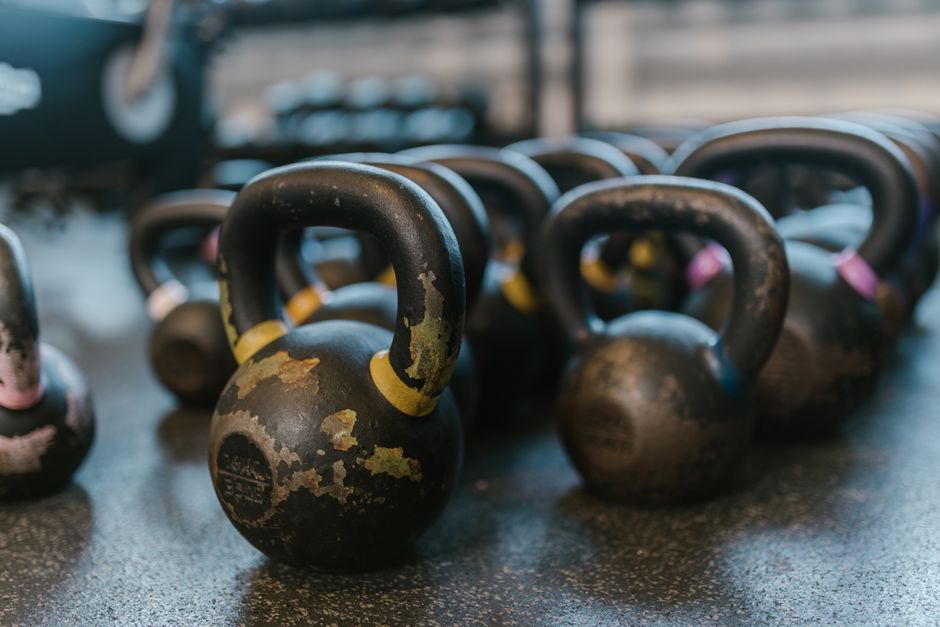
The difference is the centre of mass. With a dumbbell the load sits in your hand. With a kettlebell it hangs ten to fifteen centimetres below and outside the axis of the handle. That sounds like a detail and it changes the training effect fundamentally.
Because the load pulls at the handle rather than resting in it, every movement creates leverage that forearm, shoulder and trunk have to counteract continuously. And because the implement can be swung without letting go, ballistic movements become possible: fast contraction, fast relaxation, many repetitions in sequence.
That is precisely the quality that disappears first with age. Not the ability to lift heavy slowly, but the ability to produce force quickly. You don't catch a stumble on the stairs with maximal strength, you catch it with how fast your leg builds tension. Why strength declines faster than muscle mass in the first place is covered in the piece on strength training after 50.
Then there is the practical side, which decides success more often than any exercise physiology. A kettlebell costs 50 to 90 euros once, needs two square metres, requires no setting up, and stands in the room you are already in. The best training method is the one you actually do on a busy Tuesday.
Grip strength predicts more than blood pressure
This is where the kettlebell has an advantage almost nobody accounts for.
The PURE study followed 139,691 people across 17 countries for a median of four years and measured, among other things, handgrip strength. For every five kilograms of lower grip strength, all-cause mortality rose by 16 percent (hazard ratio 1.16, confidence interval 1.13 to 1.20). For cardiovascular mortality it was 17 percent. The authors note that in their data grip strength was a stronger predictor of all-cause and cardiovascular mortality than systolic blood pressure.
Before anyone orders a grip trainer: this is an association, not a cause. The authors themselves write that it remains to be tested whether improving strength reduces mortality. Grip strength is in all likelihood an indicator of the state of the whole system, not the switch you flip.
It is still a usable measure, and this is where it becomes practical: with a kettlebell, grip loading is not an add-on programme, it is built into every exercise. A set of twenty swings with 20 kilos is not something the forearm handles incidentally. In the BELL trial, grip strength rose by around seven kilograms on the right and six on the left after three months, and it was the outcome with the clearest change of all.
What actually happens in your back during a swing
The swing has a divided reputation. Some consider it the single best exercise for the lower back, others a herniated disc with a run-up. Both cite the same study, which is because it shows both.
Stuart McGill measured spinal loads during swings at the University of Waterloo, using EMG, ground reaction forces and a biomechanical model. With a 16-kilo kettlebell the result was around 3,200 newtons of compression on the lumbar spine, at roughly 50 percent maximal activation of the back extensors and 80 percent of the glutes.
One detail is interesting: the swing produces a posterior shear of L4 on L5, the opposite polarity to a conventional lift. That is probably why some people with years of back trouble get on well with swings in particular. In the same sentence, though, McGill notes that in a few people it irritates tissues.
Practically this means three things. The swing is a hip extension, not a squat, and certainly not a front raise with the arms. The kettlebell is fired forward by the hips, the arms are ropes. Second: 3,200 newtons is not trivial, that is training load you build up rather than repeat twenty times on day one. And third, the trunk needs baseline stability before it gets loaded ballistically. The three exercises from the piece on the McGill Big 3 are the usual preparation, and two to four weeks are usually enough.
My own first swing, incidentally, looked like a bad deadlift with momentum. A coach told me back then to imagine slamming a door shut behind me with my backside. That was the first time I understood what the movement is about.

What the evidence shows and where it is thin
This is where honesty is required, even if it makes the article less smooth.
The BELL trial is the best work on kettlebells in older adults that exists. 32 insufficiently active people aged 59 to 79, three months of normal daily activity as a comparison phase, then three months of progressive kettlebell training. The results are solid: grip strength plus 7.1 kilograms on the right, six-minute walking distance plus 41.7 metres, appendicular lean mass plus 0.65 kilograms, attendance 91.5 percent, no significant adverse events.
Now the caveats. There was no parallel control group; each person served as their own comparison. The sample is small at 32 people. The training was supervised throughout, which it rarely is in a living room. And the first author is a physiotherapist and certified hardstyle kettlebell instructor, which he disclosed, and which still belongs in the assessment.
For the underlying principle, power training in older adults, the picture is better. One meta-analysis found that power training produces muscle gains in older adults comparable to conventional moderate-velocity resistance training (standardised mean difference 0.07, no significant difference). A second found that moderate intensities deliver similar power gains to high ones, though across only three included studies with 179 participants, which the authors themselves flag as grounds for caution.
The upshot: the principle is well supported, the implement less so. Anyone claiming kettlebell training is demonstrably superior is going beyond the data. Anyone saying it is an effective and well-tolerated form of strength and power training is on safe ground.
Getting started: weight, four exercises, eight weeks

The weight is what people most often get wrong, usually by going too light. For two-handed movements an 8-kilo kettlebell is not a training stimulus for most men, it is a warm-up tool. Realistic for a man with baseline fitness is 16 kilos, for women 8 to 12. For single-arm work such as the press or the Turkish get-up, correspondingly less.
Four exercises cover most of it. Nothing more is needed in the first months.
The core exercise. Hips back, spine neutral, then extend the hips explosively and let the kettlebell fire forward. It rises to chest height and falls back, the arms only guide it. Ten to fifteen reps per set, then a real rest. If you are still standing cleanly after twenty reps, the weight is too light.
5 sets of 10–15 reps · 60–90 s restHold the kettlebell by the handle in front of the chest, squat deep, heels stay on the floor. The counterweight in front makes the squat cleaner for most people immediately, because the torso has to stay upright. Eight to twelve reps, slow down, brisk up.
3 sets of 8–12 repsOne foot forward, torso hinged, free hand braced on the thigh. Pull the kettlebell to the hip, shoulder blade first, then the arm. The trunk resists the rotation, and that is half the value of the exercise. Eight to twelve reps per side.
3 sets of 8–12 reps per sideKettlebell in one hand, walk upright, thirty to sixty seconds, then switch sides. It looks like nothing and it is the most honest exercise in the programme: when the grip gives out, the grip gives out. That is exactly the measure that responds most clearly in the studies.
3 rounds of 30–60 s per sideThe first eight weeks run in two phases. Weeks one to four without the swing: goblet squat, row and carry only, plus practising the hip hinge unloaded. From week five the swing joins in, starting at three sets of eight reps and growing over four weeks to five sets of fifteen. Three sessions a week, at least one rest day in between.
If you want this build as a finished twelve-week plan with concrete loads, progression steps and execution videos, it is in Blueprint Digital.
What a kettlebell cannot do
The biggest practical limit is the increment. Kettlebells usually come in four-kilo steps: 16, 20, 24, 28. Going from 16 to 20 kilos is 25 percent more load in one jump. With a barbell you add 2.5 kilos, a few percent. How to bridge that gap without jumping is covered in the piece on the principle of progression: more reps, more sets, shorter rests, slower lowering phases, and only then the next weight.
The second limit is maximal leg strength. A goblet squat is capped by what you can hold in front of your chest, which is considerably less than your legs could move. Anyone specifically building leg strength will need a barbell or a leg press. The kettlebell is no substitute there, and honest kettlebell coaches say so.
The third limit is technique. The swing and the get-up take more learning than a leg press. Two or three hours of instruction at the start save you months of grooving a pattern that then has to be corrected. Starting in a gym gives you that advantage anyway, and the fundamentals are in the piece on strength training after 40.
And the most honest point last: the kettlebell is not the best tool because it is physiologically superior. It is the right tool for many people in the second half of life because it lowers the barrier between intention and training to roughly zero. That is not a small advantage. Usually it is the whole difference.
Which kettlebell weight is right to start with over 50?
For two-handed exercises like the swing and goblet squat, 16 kilograms is realistic for men with baseline fitness, and 8 to 12 kilograms for women. Correspondingly less for single-arm work. The most common mistake is going too light: an 8-kilo kettlebell is not a training stimulus for most men on a two-handed swing. If you could comfortably keep going after twenty clean reps, the weight is too low.
Is the kettlebell swing dangerous for your back?
It is a serious load that has to be built up. Measurements at the University of Waterloo found around 3,200 newtons of lumbar compression with a 16-kilo kettlebell. At the same time it produces a posterior shear of L4 on L5, the opposite direction to a conventional lift, which explains why some people with back trouble get on well with it while others are irritated by it. It makes sense to spend two to four weeks on trunk stability first and then start with few repetitions.
How often should you train with kettlebells over 50?
Two to three sessions a week with at least one rest day in between. Twenty to thirty minutes per session is enough if the intensity is right. More sessions add little unless recovery grows with them, and swings are more demanding on the nervous system than the short training time suggests, because of their ballistic nature.
Is one kettlebell enough or do you need several?
One is enough for the first months. A second becomes useful once single-arm exercises come in, because those need a lighter weight than the two-handed swing. A typical pair for men is 16 and 24 kilograms, for women 8 and 12. The jump between standard sizes is usually four kilograms, which is up to 25 percent more load, so progression in between is made through reps, sets and rest periods.
Does kettlebell training replace gym strength training?
Partly. For grip strength, hip extension, trunk stability and conditioning the kettlebell is very efficient. For maximal leg strength it hits a clear limit, because a goblet squat is capped by what you can hold in front of your chest, which is well below what your legs could move. Anyone specifically building leg strength needs a barbell or leg press in addition.
Can you train with kettlebells if you have back problems?
Often yes, but not unchecked and not with the swing as the entry point. With radiating pain, numbness or loss of strength, the cause needs medical assessment first. After that the build-up starts with the goblet squat, row and farmer's carry, because these load the spine in a stable position. The swing joins in only once the hip hinge is clean without load.
Scientific sources
- Meigh NJ, Keogh JWL, Schram B et al. Effects of supervised high-intensity hardstyle kettlebell training on grip strength and health-related physical fitness in insufficiently active older adults: the BELL pragmatic controlled trial. BMC Geriatrics. 2022;22:354. PMID 35459114. doi.org/10.1186/s12877-022-02958-z — 32 participants aged 59 to 79, grip strength plus 7.1 kg, walking distance plus 41.7 m. No parallel control arm; the first author is a certified kettlebell instructor.
- McGill SM, Marshall LW. Kettlebell swing, snatch, and bottoms-up carry: back and hip muscle activation, motion, and low back loads. Journal of Strength and Conditioning Research. 2012;26(1):16–27. PMID 21997449. doi.org/10.1519/JSC.0b013e31823a4063 — around 3,200 N compression at 16 kg, posterior shear of L4 on L5.
- Leong DP, Teo KK, Rangarajan S et al. Prognostic value of grip strength: findings from the Prospective Urban Rural Epidemiology (PURE) study. The Lancet. 2015;386(9990):266–273. PMID 25982160. doi.org/10.1016/S0140-6736(14)62000-6 — 139,691 participants, HR 1.16 per 5 kg lower grip strength, a stronger predictor than systolic blood pressure.
- Orssatto LBR, Bezerra ES, Shield AJ, Trajano GS. Is power training effective to produce muscle hypertrophy in older adults? A systematic review and meta-analysis. Applied Physiology, Nutrition, and Metabolism. 2020;45(9):1031–1040. PMID 32233989. doi.org/10.1139/apnm-2020-0021 — power training matches conventional resistance training for muscle gain (SMD 0.07).
- Bandeira-Guimarães M, Blanco-Rambo E, Vieira AF et al. Chronic Effects of Different Intensities of Power Training on Neuromuscular Parameters in Older People: A Systematic Review with Meta-analysis. Sports Medicine Open. 2023;9:98. PMID 37874417. doi.org/10.1186/s40798-023-00646-9 — moderate intensities as effective as high ones, though across only three studies with 179 participants.
- Meigh NJ, Keogh JWL, Schram B, Hing WA. Kettlebell training in clinical practice: a scoping review. BMC Sports Science, Medicine and Rehabilitation. 2019;11:19. PMID 31497302. doi.org/10.1186/s13102-019-0130-z — overview of the state of kettlebell research.
Medical note
- This article is for general information and does not replace medical advice, diagnosis or treatment. With radiating pain, numbness, loss of strength, known disc damage, cardiovascular disease, or before returning to training after a long break, speak to your doctor before the first session. The study results cited describe group averages and allow no conclusions about individual cases.